
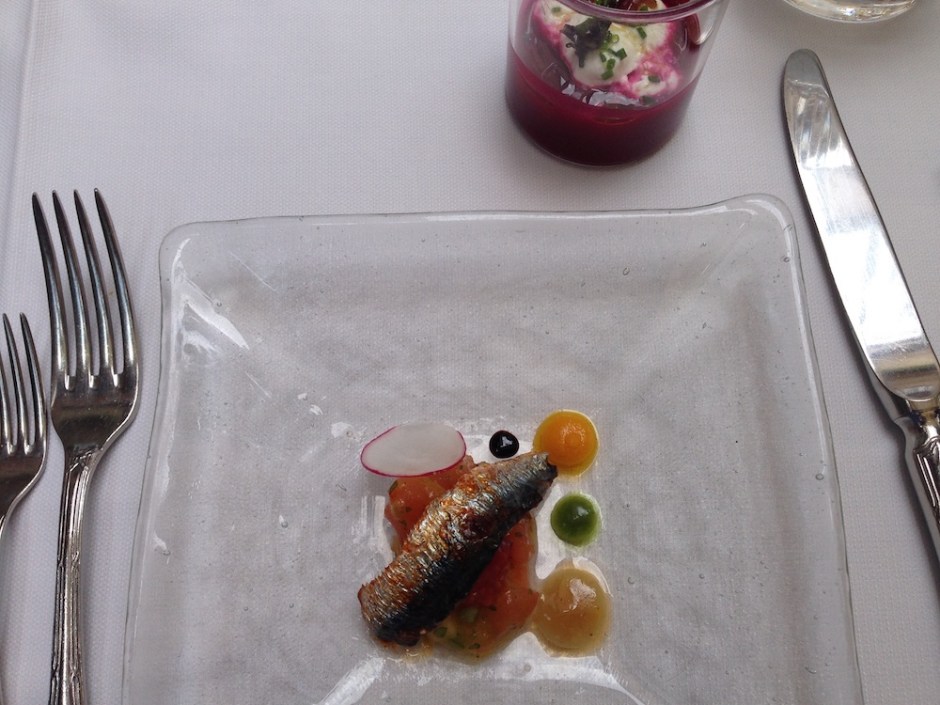
Barcelona's restaurants and bars offer a wide and wild variety of cuisines and creative dishes.
However, grazing on tapas and fine dining is both wearing on the wallet and bruising on the palate. There are times while out and about when you want something more substantial than a snack, something a little more ordinary — more home style than stylish. The kind of food the city’s bar-restaurants excel at.
Salmorejo as served at Palermo, Barcelona
Palermo is another favourite lunch spot. They offer a very good menú diari [menú del día] which regularly features traditional dishes such as codillo al horno (knuckle), estofado de vedella (veal stew) or estofado de ternera (beef stew) and, of course, paella on Thursdays. The menú includes a bottle of vino tinto (red table wine) or beer.
August 15th, 8:40am, Plaça de la Revoluciò de Setembre de 1868.
FESTES DE GRÀCIA, 2016
Time to start the party!
One of the many wonderful things about exploring Barcelona is happening across curious images in unexpected places.
Here's a graffiti I came across in Vila de Gràcia on Carrer del Perill, a few metres from Nou Can Codina and directly opposite Restaurant Gut.
I really like it. Makes me smile.
Enjoy discovering graffiti in Barcelona.
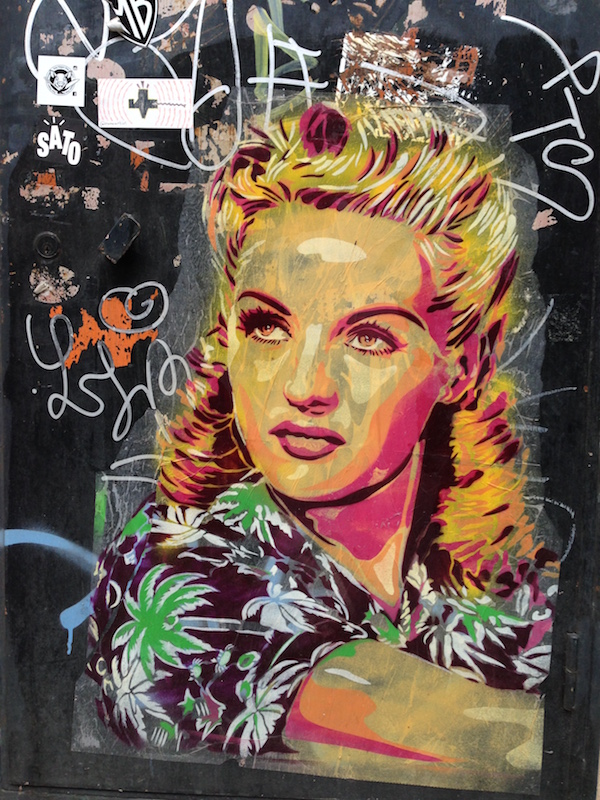
One of the many wonderful things about exploring Barcelona is happening across curious portraits of well-known, and not so well-known, people in unexpected places.
Here’s a portrait of Hollywood star, Betty Grable. Thanks to O.P. [see comments]. I had previously erroneously attributed the portrait to Rita Hayworth.
Came across it on Carrer Lleida, just off Avinguda Paral·el, not so very far from Albert Adrià’s restaurant, Pakta.
Enjoy discovering graffiti in Barcelona
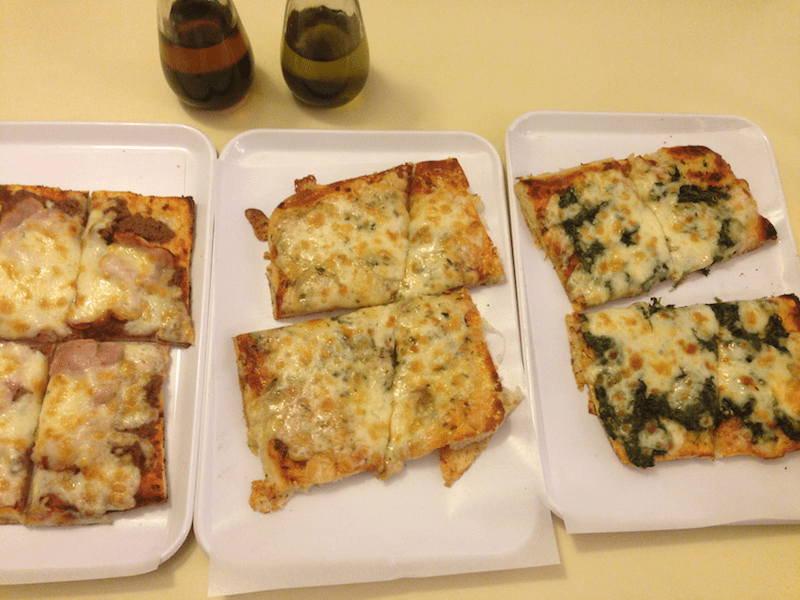
Barcelona's restaurants and bars offer a wide and wild variety of cuisines and creative dishes.
Even the most ardent foodie will confess that grazing on tapas and dining in fine restaurants is both wearing on the wallet and bruising on the palate.
When out and about there will come a time when you want something more ordinary… a tasty, light bite.
Well… you could grab a pizza.
And, one of the best places to grab a pizza in Barcelona is Lucania II in Vila de Gràcia.
For less than the average price of a Bikini (grilled ham and cheese sandwich) you can enjoy a delicious, freshly prepared pizza margarita.
Variety
20 plus variations — including one of my favourites: minced beef cooked in beer with bacon, plus two or three daily specials.
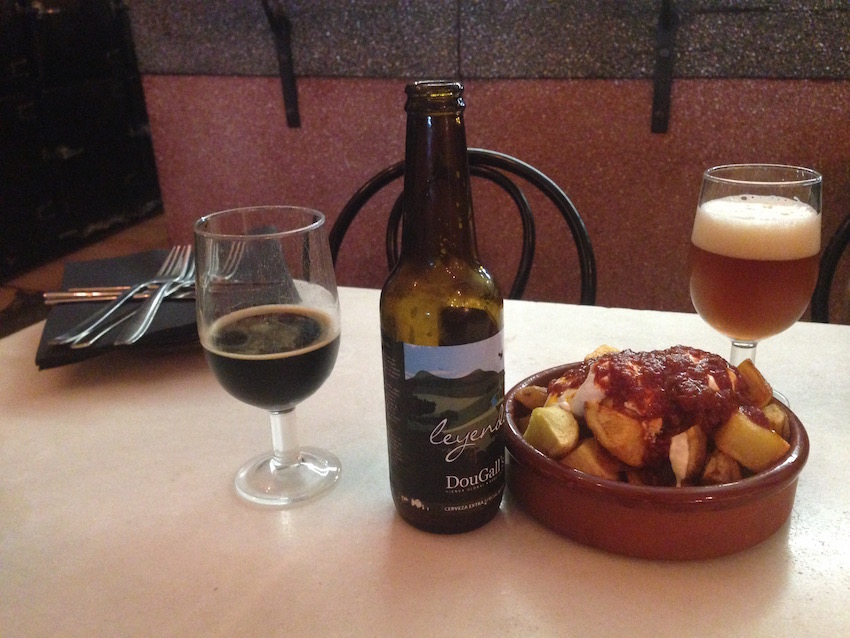
Nou Can Codina is one of my favourite bars for a beer and a bite.
It’s a favourite with the family too. We have a pet name for the place — No Can Do.
“Shall we do No Can Do?” someone might say. “Yes — let’s do No Can Do.”
And so it goes.
Then…
Not so very long ago Can Codina, one of the oldest surviving bars in Gràcia, was a humble, everyday sort of place, serving up run-of-the-mill cheap snacks and meals. It was ok for an occasional coffee or plato combinado when out doing errands. It was a dreary but honest neighbourhood bar which closed its doors roundabout 9pm every night except Sundays, when it wasn’t open at all.
Now…
After a scrub-up, a splash of paint, new lighting scheme, amazing menu, and an injection of energy and imagination the place is buzzing most evenings until 11 — and gone midnight on Saturdays.
Gentrified? No, not at all…the food and drink offered here is sensibly priced and well within the range of us ordinary folk.
Because it is now a popular joint plan to spend 10 or 15 minutes at the bar waiting for a table on a Friday or Saturday night.
The Food
Simple everyday treats are transformed into tasty, memorable delights. The patates braves (3,90€) here are very good indeed — among the very best braves in the city. And so too are the croquetas and morcilla (black pudding/blood sausage).
Whoever they have working the kitchen they need to tie down with a payrise and a golden handcuffs agreement — otherwise he or she is going to walk, and stamp their goodness on a rival establishment.
The croquetas here are fantastic — full of flavour — probably among the best in the city, and very reasonably priced at 1€. The standard options are: cocido (meat, potato and chickpea mash), merluza y gambes (hake and prawn/shrimp) and bolets (mushroom). However, check out the specials board as they often offer two or three special croquetas such as sípia (cuttlefish) and a wonderfully tasty apple with goat cheese (poma i formatge de cabra) for 1,40€.
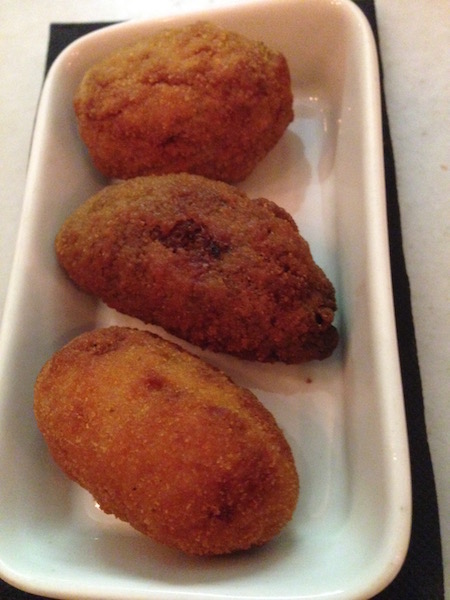
The morcilla here is also well worth trying. Moist and packed with flavour — served with a smear of parsley and garlic oil and lightly toasted bread (2,60€).
IMPORTANT: From January 1st, 2020 the T-10 travel ticket will be replaced with the T-Casual ticket.
One of the many wonderful aspects of life in Barcelona is the public transport network.
If visiting from the United States or the UK you’ll be pleasantly surprised by how clean, comfortable, convenient and reliable the local transport network is.
The quantity and quality of passenger information, in Spanish, Catalan and English (and some French) is very good.
The best way to get around the city is to use public transport.
One of the first things to do after arriving in the city is to buy a T-10 integrated transport ticket — it will save you a ton of money and a lot of hassle.
In a previous post I explained why you should consider buying a T-10 ticket when visiting Barcelona. I also told you where you can buy a T-10.
However, partly as a resuIt of a friend’s mishaps during a recent visit to Barcelona, I’ve since realised that I overlooked to tell you HOW to use the T-10.
I use a T-10 at least twice, sometimes five or six times every day during the working week. It really is quite simple, however, I can understand how visitors from an area without an integrated transport system could feel a little daunted by the process.
So, here’s a guide to using the mighty T-10.
How to use the T-10 on the Metro (subway), local trains (RENFE Rodalies/Cercanias and FGC) and Funiculars:
First, buy your ticket.
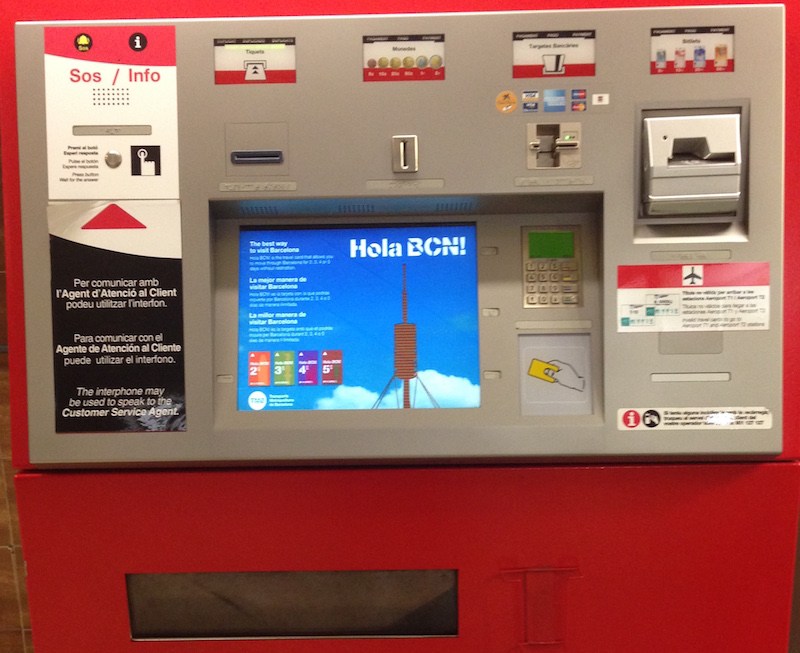
There are not many staffed ticket offices where you can buy a ticket, and if you haven’t already purchased your T-10 at a tobacconists, newsagent or news kiosk (street newsstand) (some bakeries and other shops also sell T-10s) you will have to use a machine in a Metro station or at a Tram stop — these machines will be marked with the TMB logo (as in the photo below). You can also buy a T-10 at ticket machines at RENFE (Spanish national rail service) rail stations (these machines are coloured grey) and at FGC (Catalan national rail service) rail stations — these machines are coloured orange.
There are also a few ticket machines near bus stops on Diagonal, however these machines only accept credit/debit cards, and are so few and far between that they are not worth your time looking for.
-
- Search the touchscreen for the T-10 ticket icon.
-
- In the bottom right corner of the screen you’ll see four flag icons indicating which languages are available: Catalan, Spanish, English and French. Tap the union jack for English.
-
- Tap the T-10 ticket icon.
-
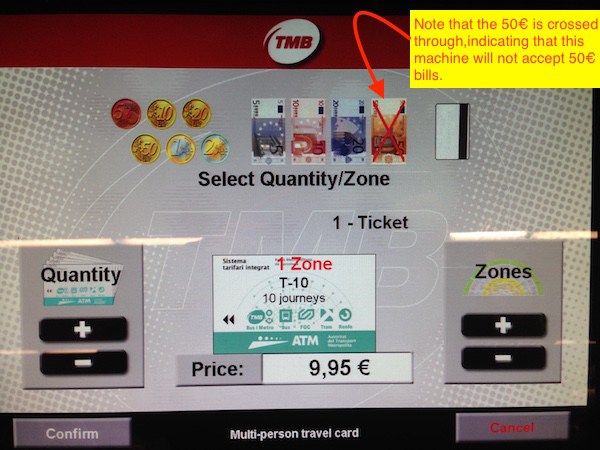
- The screen will change and show you the current price (10,20€) and give you the option of buying multiple tickets by tapping the + symbol on the left of the screen.
-
- You are also able to change the Zone by using the + and – symbols on the right of the screen.
-
- Make sure you have the correct quantity and Zone and tap Confirm in the bottom left of the screen, or Cancel in the bottom right of the screen if you have made a mistake.
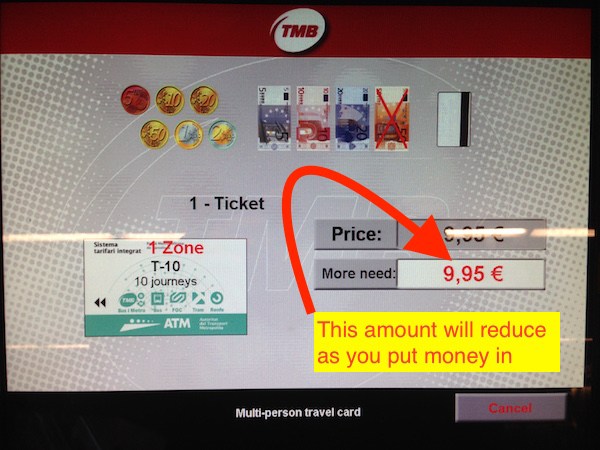
- The screen will change and show you the total cost of the the ticket(s) and how much you have to pay in red.
These three images illustrate the above:
BUY WITH CASH
Insert coins in the vertical slot above the screen, or insert a note (bill) up to the value of 20€ in the horizontal slot to the right of the screen, or if buying more than two T-10s, multiple notes/bills. (Please note: As at writing most machines do not accept 50€ notes/bills).
The most frequent cause of first-time users’ frustration is incorrectly inserting notes/bills.
When inserting notes/bills be careful to place the note the correct way up as shown in the graphic above the slot.
The machine will issue change and deposit your ticket in the tray below the screen. You’re good to go.
BUY WITH CREDIT/DEBIT CARD
-
- Find the T-10 icon on the touchscreen.
-
- Tap the T-10 icon.
-
- Select how many tickets you require and which Zone you require using the + symbols.
-
- Place your card in the horizontal slot to the right of the touchscreen.
-
- The machine will read your card and accept or deny it.
-
- Then, on the card reader screen you will see the instruction to enter your PIN number using the keypad and the OK button, marked with a green tag in the bottom right of the keypad.
-
- Then, all being well, you will see a message on the card reader screen,”Mastercard (or whatever your card name is) XXXX with the amount that has been paid.
-
- Then, you will see the instruction ‘Extregui’ telling you to extract your card. Remove your card.
- The machine will deposit your ticket in the tray below the touchscreen.
IMPORTANT: Remember to remove your card. The machine does not emit any audible warning, as do ATMs, if you leave the card in the slot. If you do inadvertently leave your card in the machine then after 30 seconds or so the machine will swallow your card. If this happens the only way to retrieve your card is to go to the TMB customer services office in Diagonal metro station the following day. Station staff do not have any way of opening the machines — they can only be opened by cash collection staff.
Ok, so you’ve got your ticket…now, how to use it.
There are 3 types of ticket barriers:
-
- Turnstiles: These are the most common.
-
- Plexiglass doors: These are usually found in recently built or refurbished stations.
- Extra-wide plexiglass access points: For people in wheelchairs or electric buggies and people with child buggies or bicycles and/or lots of luggage.
Turnstiles
-
- Place your T-10 the correct way up (i.e. printed with T-10 and green icons) with the white arrow in the bottom left corner pointing toward the slot.
-
- Retrieve your T-10 from the slot at the back of the machine.
- Pass through the turnstile to your RIGHT as indicated by the black arrow in the photo below.
Plexiglass doors
-
- Place your T-10 face up (i.e. printed with T-10 and green icons) and with the white arrow in the bottom left corner pointing toward the yellow plastic horizontal slot.
-
- Retrieve your T-10 from the pop-up slot.
- Pass through the plexiglass doors to your LEFT as indicated by the two illuminated green arrows in the photo below.
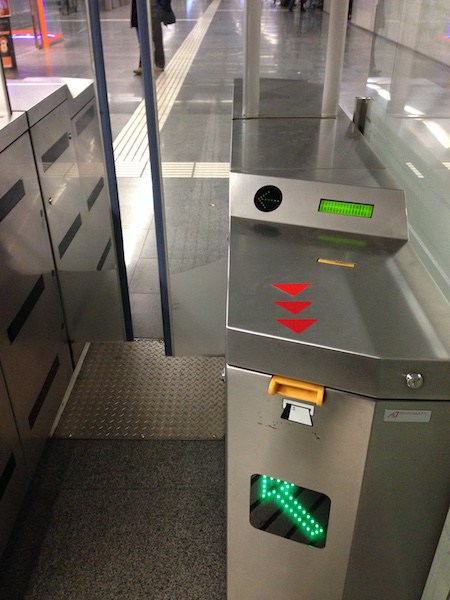
You’re on your way…now go find your platform/track.
How to use the T-10 on the bus network:
- Buy your T-10 as above. Bus drivers cannot sell you a T-10 — they can only sell a senzill (single/one-way) ticket (2.20€).
- Get on the bus at the front of the bus, NOT the middle nor the back. Having said, that the newer articulated (‘bendy’) busses do allow passengers to enter the bus using the middle door. These busses have middle doors with a flashing green button, similar to the buttons on many Metro carriages.
- Say ‘Hola’ to the driver and smile or nod.
- As you file along the gangway you’ll immediately see two ticket machines — one on your left and one on your right. Be aware that the newer articulated (‘bendy’) busses have three ticket machines.
- Insert your T-10 with the white arrow pointing downwards into the red slot at the top of the machine.
- The machine will make a sound and tell you how many rides you have left and your ticket will pop up.
- Remove your ticket, put it somewhere safe and find a seat, or shuffle along the bus.
- IF your ticket is used-up or defective the machine will make a loud intermittent beep. This is when you panic, frisk yourself for another T-10, realise you don’t have one, and before you can decide to backtrack and get off the bus the doors are already closed and the bus is on its way to the next stop. Oh no!
- IF this is the case — choose an appropriate moment, dip into your pocket and find 2,20€ in change and pay the driver for a single/one-way ticket.
- Say thank you/gràcies to the driver and take deep breath of relief — they have just saved you from a potential fine of 100€.
[Remember — a T-10 is a multi-person ticket. So, if you have no rides left on your T-10, and travelling with a friend, you could always ask to use their ticket.]
Here’s a photo of a ticket machine on a bus:
How to use the T-10 on a tram:
- Buy your T-10 from a machine as described above, or from a machine at the stop.
- Board the tram.
- Find a machine (very similar to the machines on a bus) which are attached to poles near every door
- Insert your ticket in the slot with the white arrow pointing downwards.
- The machine will make a sound (described as a ‘bip’ in the helpful information).
- That’s it…you’re on your way.
Transfers and duration of travel:
You need to know that you can use the T-10 to switch between various modes of transport on your route for up to 1 hour and 15 minutes and it counts as a single journey/ride.
However, be aware that you can only use 3 different modes of transport, e.g. bus, metro, train, or metro — train — funicular, or train — metro — tram etc.
For example, you could take a barrio bus (local public mini-bus) to connect with a regular bus to connect with the metro to then connect with a tram, i.e bus—metro—tram. If you do all that in one hour and fifteen minutes from the start of your journey it only debits your ticket by one journey. However, note that once you leave the metro system you will have to use another journey when re-entering the metro.
IMPORTANT: Keep your ticket flat. If the ticket gets bent or torn then it will likely not work. You can take your damaged ticket to a TMB Customer Services office (in Diagonal, La Sagrera and Universitat metro stations) and they will issue you with another ticket. You could also ask at an office in a metro station — if you’re patient and polite the staff can, though they are not obliged to, issue you with a new ticket with the correct number of journeys.
LINKS:
Visiting Barcelona? What you need know about the T-10 in Barcelona.
Enjoy getting around Barcelona
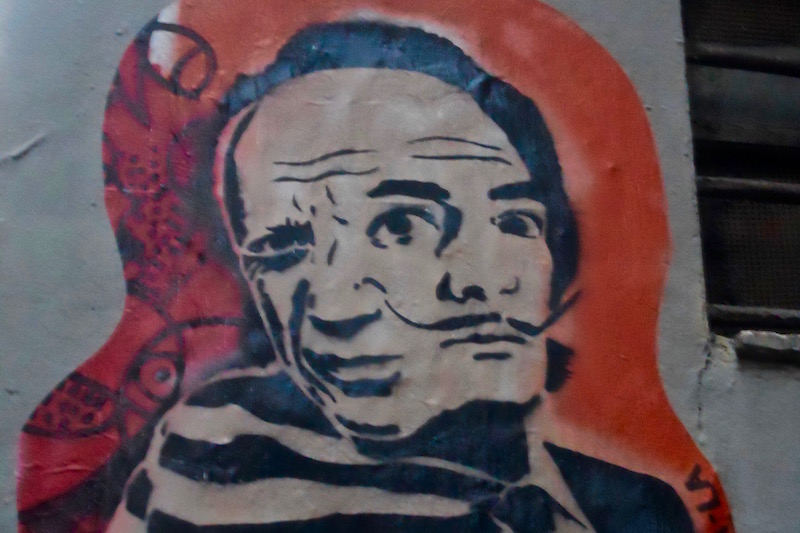
Graffiti portrait of Picasso & Dalí in Ciutat Vella
One of the many wonderful things about exploring Barcelona is happening across curious portraits of well-known, and not so well-known, people in unexpected places.
Here’s a graffiti portrait of Picasso and Dalí, almost like Siamese twins joined at head and shoulder, in Barri Gòtic, Ciutat Vella.
Enjoy discovering graffiti in Barcelona
One of the many wonderful things about exploring Barcelona is happening across curious portraits of well-known, and not so well-known, people in unexpected places.
Here’s a graffiti portrait of Fidel Castro in Vila de Gràcia.
And a link to a graffiti portrait of Fidel’s comrade-in-arms, Enesto ‘Che’ Guevara HERE.
