Sculpture

Submarine in Barcelona

15th September 2015

One of the many wonderful things about exploring Barcelona is happening across curious sculptures in unexpected places.

Here’s a sculpture of a submarine by Josep Maria Subirachs in Dreta de l’Eixample at the junction of Avinguda Diagonal/Carrer Provença and Carrer de Girona.

The sculpture commemorates Narcís Monturiol’s invention of the first submarine, Ictineo II, powered by an engine.

Here’s a detail of the underside:

The Inventor

Narcís Monturiol i Estarriol (b. 1819 — d. 1895) was a curious character, in all senses of the term. He was a Utopian communist and a friend of Ildefons Cerdà, the engineer who designed the Eixample.

The Artist

Josep Subirachs, who died in 2014, is the same artist responsible for the Passion Facade on the Sagrada Familia, and the large sculpture of inverted steps (Monument to President Macià) installed in Plaça Catalunya.

The nearby bar-restaurant, Morryssom, has a few prints by Subirachs in the downstairs bar.

Here’s a detail from the base of the sculpture:


LINKS:

Here’s a Wikipedia page in English about Ictineo II, the submarine featured above: HERE.

Here’s a Wikipedia page in English about Narcís Monturiol: HERE.

Here’s a Wikipedia page in English about Josep Maria Subirachs: HERE.

Here’s my Spotted by Locals write-up about Morryssom: HERE.

And, here’s a link to an interesting feature about submarines in Barcelona: HERE.
Enjoy discovering sculpture in Barcelona.

Sculpture

The Pigeon Girl, Plaça del Diamant in Barcelona

8th September 2015

One of the many wonderful things about exploring Barcelona is happening across curious sculptures in unexpected places.

Here is a sculpture by Xavier Medina Campeny, a representation of La Colometa (the Pigeon Girl), or Natalia, the main protagonist of Mercè Rodoreda’s novel, In Diamond Square (previously published as In the Time of the Doves).

This powerful, human-sized sculpture is situated in Plaça del Diamant, Vila de Gràcia.

Here’s a detail of the pigeons:

Here’s a photo showing something of the context taken from the terraza outside Café Diamant:

LINKS:

Here’s my write-up at Spotted by Locals: HERE.

Enjoy discovering sculpture in Barcelona.


Graffiti

Che Guevara in Barcelona

1st September 2015

One of the many wonderful things about exploring Barcelona is happening across curious portraits of well-known, and not so well-known, people in unexpected places.

Here’s a graffiti portrait of Che Guevara in Gràcia.

Go HERE for a portrait of Che’s comrade-in-arms, Fidel.

Enjoy discovering graffiti in Barcelona

Graffiti

Amelia Earhart in Barcelona

25th August 2015

One of the many wonderful things about exploring Barcelona is happening across curious portraits of well-known, and not so well-known, people in unexpected places.

Here’s a graffiti portrait of the pioneering aviator (or, should that be aviatrix?), Amelia Earhart in Poble Sec.

Here’s a LINK to an interesting story about Earhart in The Guardian.

Enjoy discovering graffiti portraits in Barcelona

Snacks

Edible Bikinis in Barcelona

20th August 2015

Barcelona is a culinary capital offering a wide and wild variety of cuisines and creative dishes. However, grazing on tapas and dining in fine restaurants can be both wearing on the wallet and bruising on the palate.

There sometimes comes a time when you just want something more ordinary, a light bite to fill a hole while out and about.

Well, you could try a Bikini.

Bikini?

Yes, Bikini. When wandering around the city you’ll see the word Bikini scrawled on chalkboards outside snack bars. It’s a very popular snack, probably the most popular snack after the ubiquitous patates braves [patatas bravas in castellano].

A Bikini is a grilled ham and cheese sandwich.

The name, Bikini, is unique to Barcelona and Catalunya. Try ordering a Bikini outside of Catalunya and you’ll prompt incomprehension, a measure of confusion, and perhaps a little argument; in Spain a Bikini is known as a mixto.

History

The sandwich, similar to un croque monsieur in France, is said to have been so christened here, in Barcelona, in 1953.

To check out the history of the Bikini GO HERE

Test

There are two food tests for any snack bar in Barcelona — the Braves test and the Bikini test.

Continue Reading…

Graffiti

Amy Winehouse in Barcelona III

18th August 2015

One of the many wonderful things about exploring Barcelona is happening across curious portraits of well-known, and not so well-known, people in unexpected places.

Here’s another graffiti portrait of Amy Winehouse which appeared in Vila de Gràcia on Carrer Mozart during the Festes de Gràcia in August, 2015.

For more graffiti featuring Amy Winehouse go HERE, HERE and HERE.

Enjoy discovering graffiti portraits in Barcelona

Dictatorship

Franco in Barcelona

12th August 2015

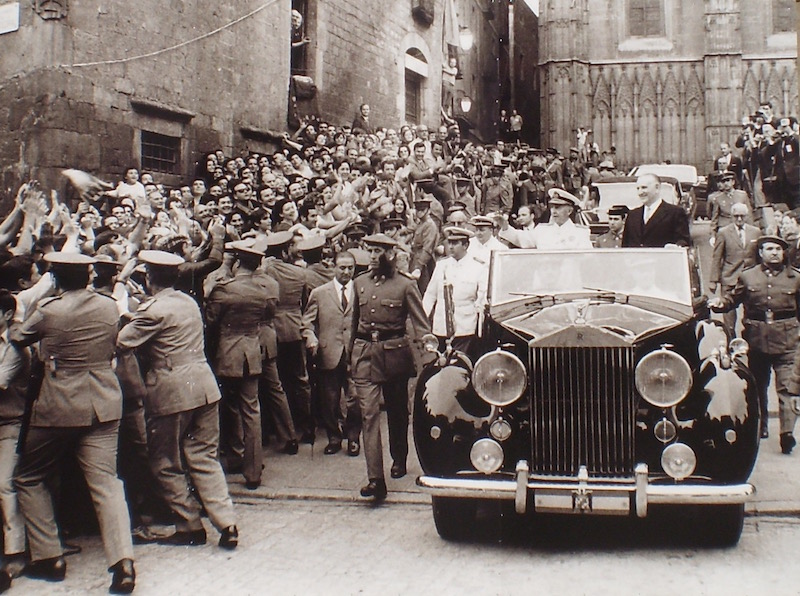
Here’s a photo of the dictator, Generalísimo Franco, the self-proclaimed Caudillo, accompanied by the then mayor of Barcelona, the notorious, Porcioles.

The photo was taken on June 16th, 1970, during Franco’s final visit to the city, five years and five months before his long and drawn out demise.

Franco’s aides ordered medical staff to keep the comatose, El Caudillo ‘alive’ until November 20th — the exact same date as the deaths of both José Antonio Primo de Rivera, son of a previous dictator and founder of the Falange, and Buenaventura Durruti, the very popular anarchist militant. But that’s another story for another day.

Where was the photo taken?

Continue Reading…

Graffiti

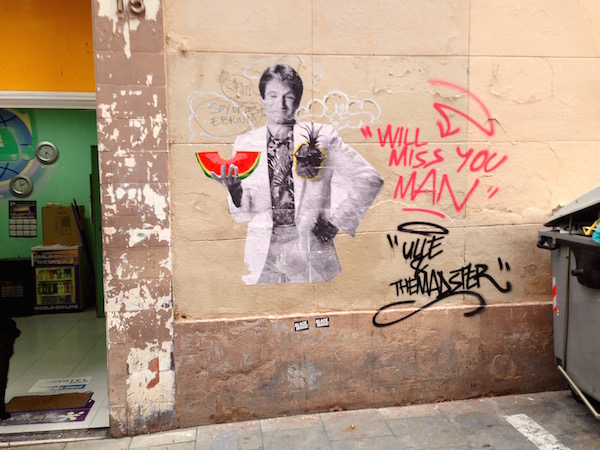
Robin Williams in Barcelona

11th August 2015

One of the many wonderful things about exploring Barcelona is happening across curious portraits of well-known, and not so well-known, people in unexpected places.

Here’s a graffiti portrait of Robin Williams in Gràcia.

Robin Williams in Gràcia2

It went up on the wall the very next day after his death was announced — a year ago today.

Enjoy discovering graffiti portraits in Barcelona

Tapas

Zarajo in Barcelona

6th August 2015

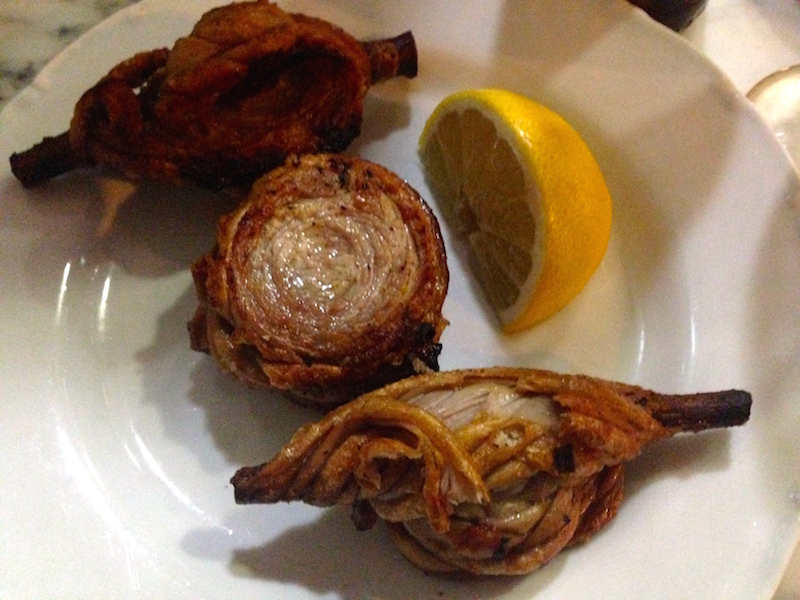
�Zarajos as served at�Morryssom

One of my favourite tapas dishes is Zarajo, braided sheep’s intestines wrapped around a vine branch and usually broiled, though often grilled, sometimes smoked, served hot with a wedge of lemon.

Very tasty.

Zarajo are not common in Barcelona, the dish originated in Cuenca, the city in Castilla La Mancha.

Zarajo go well with a beer, though I recommend you try them with a glass of rough, strong red wine.

Two places which I know serve zarajo are:

  • Morryssom’s,�one of my favourite lunch restaurants and tapas places.
  • Bar L’Amistat, Carrer de Torrijos, 13, in Gràcia. IMPORTANT: L’Amistat as was is now CLOSED. It’s still called, Bar L’Amistat, but is now just another would-be trendy bar and they do not serve zarajo.

Zarajo as served at Bar l’Amistat, GrÃ�cia.

Bon profit!


Â�Zarajo as served atÂ�Bar L’Amistat

Enjoy!

The Transition

Battlefields in Barcelona 2: Passeig de Sant Joan, February, 1976

5th August 2015

The streets of Barcelona comprise a battlefield which has hosted, and continues to host, skirmishes and more enduring clashes between armed police and local people.

The streets of Barcelona have seen fierce battles over issues such as workers’ rights, the all-pervasive influence of the Church, education, Republicanism, a Stalinist coup, representative democracy, national independence, workers’ self-management, property speculation, squatters’ rights, forced evictions and revolution.

The city’s layout has been largely informed by the needs of the army.

For example:

  • Via Laietana, was deliberately created to allow cavalry units to disperse hostile crowds forming outside the inner city walls.
  • Avinguda Diagonal was created to enable rapid access to the heart of the city by troops based in barracks in Gràcia and Pedralbes.
  • Parc Ciutadella was once the site of an enormous miltary citadel.
  • The castle on Montjuïc, was only handed to the city in 2008; until 1963 it was a prison run by the military to incarcerate and sometimes execute, dissidents.

1976: Los Grises on Passeig de Sant Joan

Continue Reading…