Architecture

6 Modernista Details in L’Antiga Esquerra de l’Eixample, Barcelona

4th August 2015

One of the many wonderful things about exploring Barcelona is happening across curious architectural details in unexpected places.

You could be on a shopping expedition — the above entrada in L’Antiga Esquerra de l’Eixample is adjacent to a Bon Preu supermarket — or out with friends — this magnificent entrance is just a few metres from the restaurant, Gresca — or just taking a stroll, and pass by a beautiful entrance.

Look — but don’t intrude

It’s difficult sometimes to not stick your nose in, take a gander and snap a few photos.

PLEASE DON’T — unless it’s a civic building, hotel or office building. The residents won’t like you for it, and the portera/o [concierge] will almost certainly hustle you out of the building and call the police if you resist.

You could politely try asking the portera/o if you can take a few photos — some will oblige (while keeping a very close eye on you) but many won’t.

Instead, linger a little, savour the moment and walk on slowly by.

I am a frequent guest to this apartment building and enjoy the trust of both residents and the portero.

Film location

This apartment building has featured in a few movies, the most recent being, Mientras Duermes (While you sleep) although titled, Sleep Tight, in English — a creepy and coldly credible horror flick.

Lighting:

Walls:

Here’s a close-up of the relief work adorning the walls:

Stair rail and newel:

Lift/Elevator Doors — showing ironwork, stained glass and woodwork:

Windows:

Here are two photos of the interior window casements:


And here’s a snap of an interior window in the lift/elevator shaft:

Doors:

Here are two photos of an apartment exterior door:
And, finally, a view of the entrance looking toward the exterior doors:

Enjoy Barcelona’s architecture.
Lunch

The Secret Life of the Menú del Día

30th July 2015

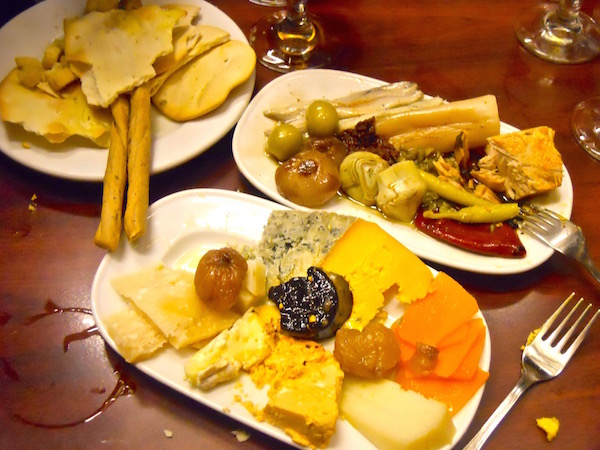
Spain’s most popular lunchtime deal — the menú del día — was invented for the convenience of tourists. Ironically, most tourists are not aware it exists.

When visiting Spain you’ll save yourself a ton of money, and discover some wonderful food offerings, if you adopt the local custom of eating your main meal of the day between 1.30pm and 4pm and opt for the menú del día.

Opting for a menú del día will relieve you of the stress of:

a) not knowing what the final bill (check) will be before you sit down;

b) wading through a seemingly endless menu of dishes you may not be familiar with;

c) choosing a wine to accompany your meal.

Another good reason to try a menú del día is that you’ll encounter and rub shoulders with natives, as opposed to other visitors. Rafa Peña, the highly regarded chef at Gresca, says,
“In the evening 70% of our diners are foreigners, at lunchtime almost 90% are Barcelonins.”
On a good day, nothing beats a good, long, chatty menú del día with close friends or family.
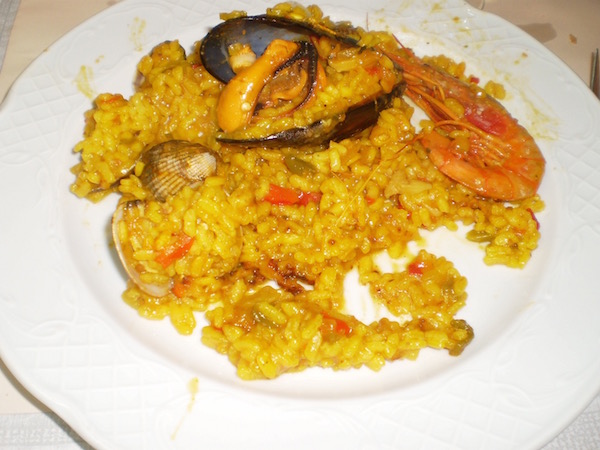
Paella served as a first-course as part of a menú del día.

Paella served as a first-course as part of a menú del día.

So, what is a Menú del día?

Most restaurants in Spain, even Michelin-starred establishments, will offer a menú del día — menu of the day — a fixed-price lunch, Monday to Friday.

A menú del día will usually offer a choice of 5 or 6 first-courses, 5 or 6 second-courses, 5 or 6 desserts, wine, water (or beer or soft drink) bread and coffee, for an all-inclusive price of anywhere between 6,50€ and 30plus euros including service and tax.

Continue Reading…

Architecture

Gaudí’s Dragon Gate in Barcelona

23rd July 2015

One of the many wonderful things about exploring Barcelona is happening across curious architectural details in unexpected places.

Had to go to a meeting at the Polytechnic in Pedralbes the other day, and the route took me past Finca Güell and the magnificent dragon gate designed by Gaudí.

The finca was a home farm and summer residence owned by Gaudí’s patron, Eusebi Güell — yes, the same guy who funded the development of Park Güell. The gate gives access to beautiful gardens decorated with typical Gaudí flourishes.

Because of refurbisment works admission to the gardens and adjacent Gaudí designed Pavellons (Pavilions) is currently limited. But it is possible to visit the gardens between 10am and 4pm on weekdays. The cost of admission is 4€. There was a children’s puppet theatre show in the gardens the day I walked past.

It is hoped to fully re-open the Pavilions and gardens at some point in the near future. As at January, 2020 the gardens are still closed for refurbishment.

More visitor information HERE

Gaudí designed several gates and gateway features. There is another Gaudí gate in Sarrià. Go HERE for details.

Enjoy exploring Barcelona

Getting Around

Visiting Barcelona? What you need know about the T-10 in Barcelona.

16th July 2015


One of the many wonderful and undersung aspects of Barcelona is the public transport network.

If visiting from the United States or the UK you’ll be pleasantly surprised by how clean, comfortable, convenient and reliable the local transport network is.

The best way to get around the city is to use public transport.

One of the first things to do after arriving in the city is to buy a T-10 integrated transport ticket.

Think of it as your magic key to unlocking the city.

Why?

Because you’ll save a ton of money, save yourself a lot of time and hassle, and get to visit many more places and enjoy many more experiences.

Cost:

  • 10,20€ (for Zone 1)

Where to buy:

You can buy a T-10 [tay-dee-eth] from tobacconists, newspaper kiosks and newsagents, as well as all metro (subway) stations and all the main rail stations.

The touch screen ticket machines at metro and rail stations are easily navigated and accept cash (but, in many cases, NOT notes/bills larger than 20€) and most debit and credit cards.

They’re pretty reliable — I’ve only three times (in 16 years) had a problem with them — and I use a T-10 at least twice, sometimes five or six times every day during the working week.

Should you have a problem you can press a panic button and speak with someone who will help you. In larger metro and rail stations there will be staff around to help you.

Here’s what you need to know:

You need to know that the T-10 is a multiperson, multi-use ticket, which means one person can use the ticket 10 times or 10 people can use it once, and every variation in between.

You need to know that a T-10 ticket is valid for travel on:

  • Busses, including night busses
  • The Metro
  • Local trains run by FGC, the Catalan public railway system
  • Local trains, known as Rodalies (or Cercanias in Spanish) run by RENFE, the Spanish national rail system
  • Trams
  • And two funiculars.

Exceptions:

You need to know that the T-10 is NOT valid for:

ZONES: Continue Reading…

The Transition

Battlefields in Barcelona 3: Els Jardinets, February,1976

9th July 2015

The streets of Barcelona comprise a battlefield which has hosted, and continues to host, skirmishes and more enduring clashes between armed police and local people.

The streets of Barcelona have seen fierce battles over issues such as workers’ rights, the pernicious, all-pervasive influence of the Church, education, Republicanism, a Stalinist coup, representative democracy, independence, workers’ self-management, property speculation, squatters’ rights, forced evictions and revolution.

The city’s layout has been largely informed by the tactical manoeuvre needs of the army. For example, Via Laietana, was in part created to allow cavalry units to disperse hostile crowds forming outside the inner city walls. Avinguda Diagonal was created, in part, to enable rapid access to the heart of the city by troops based in barracks in Pedralbes. Parc Ciutadella was once the site of an enormous miltary citadel. The castle on Montjuïc, was only handed to the city in 2008; until 1963 it was a prison run by the military to incarcerate and sometimes execute, dissidents.

1976: Los Grises in Els Jardinets

Continue Reading…

BLOG

A week before Learning to Drive in Barcelona

6th July 2015

A glimpse of how life is lived here.

Sunday

Caught up with a friend from the States en route to Italy.

We headed to Bar Bodega Quimet for a few vermuts before grazing around and settling awhile in a tapas bar, Gastarea, on Carrer Verdi, which I’ve never visited before, to enjoy a couple of montaditos before tucking into plates of bacalao al pil pil and pebrots de Padrón. I’ll be back.

After a stroll, and a relaxed cocktail at La Cigale, we ended the night in one of my favourite drinks bars, El Cine on Carrer del Torrent de l’Olla.

Monday

First thing, met with an esteemed international theatre and opera director to discuss his forthcoming visit to the Edinburgh festival.

Later, after spending an hour or so on a novel in progress (Heavensfield), and an hour or so on a non-fiction book (How to Eat like a Local in Barcelona), I met with a trusted friend at his parents’ apartment in L’Antiga Esquerra de l’Eixample. We discussed plans for a very special tri-lingual wine-tasting I’ll be hosting in November.

Entrance to an apartment building on Carrer Provença in L’Antiga Esquerra de l’Eixample

Tuesday

Today that once very special design store, Vinçon opened and closed its doors to the public for the very last time. I didn’t go along. I’d read Quim Monzó’s piece in La Vanguardia and… well, for slightly different reasons…couldn’t face it. Something about being here, in Barcelona, has now died.

Thursday

In the evening I met with the film-maker, Justin Donlon, at Gredos, a granja, or snack bar, across the street from Verdaguer metro, to discuss my role in a planned documentary about the artist, Geoff Harwood.

Friday

In the evening, we met up with dear friends at Gredos and went along to a Beer Festival in Poblenou. It was a good do, and a grand time was had by all.

Saturday

In the evening my better half, her son and I met at Bar Oller for a drink before traversing across Gràcia to a 22:20 screening of Isabel Coixet’s, Learning to Drive at Cines Verdi. We dropped into Bar l’Amistat, where we had morros and zarajos, before calling in at Lucania II, where we hoped to spend time enjoying slices of delicious pizza. However, it was really very busy, as always, and the clock was against us. We ate what we could but, at the end, had to ask for a doggy-bag. But it was still delicious, excellent pizza, which we scoffed surreptitiously during the movie.

The movie, Learning to Drive, starring Ben Kingsley, and directed by local dirctor, Isabel Coixet, was ok, verging on good. The acting, camerawork and editing all superb. But for me, the script lacked a certain necessary tension.

Enjoy Barcelona.

Celebrations

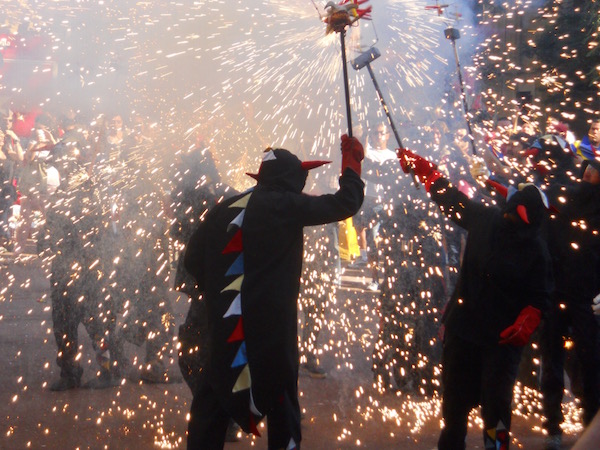
Hot as hell and raining fire in Barcelona

2nd July 2015

One of the many wonderful things about exploring Barcelona is turning a corner and happening across curious festivities in unexpected places.

You never quite know… you may meet the Devil.

They told you, “The Devil has no friends…” They were lying.

Correfoc, Gràcia, Barcelona, August, 2014`

He also has pets…

And a friend who wears shades…

And friends who enjoy a spot of fiery yoga and pilates in the morning…

Enjoy Barcelona.

Tapas

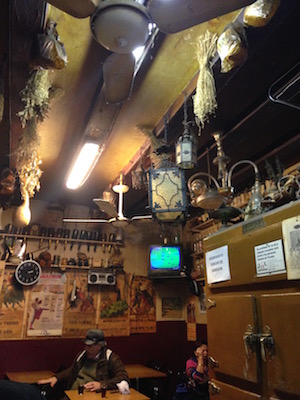
5 Traditional bodegas in Barcelona

18th June 2015

Some bodegas serve the best little plates and tapas in the city

So, what is a bodega?

At its most simple a bodega is where us locals buy everyday wines from the barrel, and occasional wines, cavas and spirits by the bottle or case. In short, an off-licence, or liquor store, where quality wines are considerably cheaper than in supermarkets, and where you can sample the wines before you buy.

What is a bar bodega?

A bar bodega is a bodega with a bar, serving wines, beers and spirits — and, often, little bites.
As well as serving quality wines at affordable prices you’ll find some bodegas serve the best little plates and tapas in the city — anything from simple olives, cured meats and cheeses, through elaborate montaditos, to epicurean delights such as angulas (elvers) and Russian royal king crab.

What is a bar bodega-restaurante?

A bar bodega-restaurante is a bodega with a bar which also serves more substantial meals, an example is Bar Bodega Restaurant Gelida.

Plate of food at Quimet i Quimet, Poble Sec, Barcelona

Tapas at Quimet i Quimet.

Not so long back every barrio had maybe eight or more bodegas, where neighbours would meet for gossip over a vermut or a beer as they bought their family ration of booze. As incomes rose and tastes changed, and supermarkets moved in, bodegas fell out of favour or morphed into wine stores.

Bar Bodega Cal Pep in Gràcia.

And now — with owners cashing up and retiring — young savvy owners are taking their place, and with customers looking to save money — bodegas are back.
There are some that have always been around — check out Bodega Montse —a beautifully filthy relic of the 1890s:

BAR BODEGA MONTSE, Raval, Barcelona by Louisa Averiss

And now, in place of the old jug and bottle shops, two distinct types of revamped bodegas are emerging — those positioned to appeal to a more affluent set — offering imported beers and premium brand spirits, where the ambience is more like a wine bar; and those which have retained the look, feel and smells of traditional bodegas which, with the addition of craft beers and exquisite snacks, appeal to a younger, more casual set.

Here are a few traditional though thriving bodegas you may want to check out:

Bar Bodega Quimet in Vila de Gràcia.

Bar Bodega Montse in the Raval.

Bar Bodega del Poblet very near the Sagrada Familia.

Bar Bodega E. Marin in Vila de Gràcia.

Bar Bodega Quimet i Quimet in Poble Sec.

Enjoy.

Sculpture

Anne Frank in Barcelona

11th June 2015

One of the many wonderful things about exploring Barcelona is happening across curious sculptures in unexpected places.

Location:

In Vila de Gràcia, on Travessia de Sant Antoni, midway between Carrer d’Astúries and Carrer del Montseny, you’ll find the little square, Plaça d’Anna Frank and a sculpture of Anne Frank. She reclines on a canopy affixed to the Centre Artesà Tradicionarius — a cultural centre dedicated to the production and promotion of Catalan music and dance.

The scuplture is by the Catalan artist, Sara Pons Arnal.

An inscription inside the book reads:

“While even the names of her executioners are gone, she lives on. But may the long shadow, and the river of blood and tears and mud and mourning that snuffed out so much beauty, never return, the symbol of which was a young girl in bloom.”

Enjoy discovering sculpture in Barcelona

Getting Around

How to get your bearings as you explore Vila de Gràcia in Barcelona

4th June 2015

Educated monkey calculators and compasses as displayed at Vinçon.


Arrival

Well done, you’ve arrived ready to explore Vila de Gràcia. Congratulate yourself on your good judgement.

  • If you arrived via metro Line 3 and alighted at Fontana you are now at the junction of Gran de Gràcia and Carrer d’Asturies. If you alighted at Lesseps you will be very near the junction of Gran de Gràcia with Traveserra de Dalt.
  • If you arrived via metro Line 4 at Joanic you will be at the junction of Carrer Pi i Maragall with Carrer de l’Escorial.
  • If you arrived by FGC train you’ll be on Via Augusta, in, or very close to Plaça de Gal·la Placidia, and very near the junction with Traveserra de Gràcia.
  • If you arrived by the 22, 24 or V17 bus you will be on Gran de Gràcia.
  • If you arrived on the V15 bus you’ll be on Via Augusta.
  • If you arrived on the 55 bus you’ll be at the junction of Passeig de Sant Joan and Traveserra de Gràcia.
  • If you arrived on foot, by bike, or fell from the skies — well, you could be anywhere, but not so very far from somewhere.

Orientation

First thing to understand is that although most maps seem to show Gràcia as being North of the city centre, because most maps situate the city as being between the mountain (usually at the top of the map) and the sea (usually at the bottom of the map) Gràcia is really north-west of the city centre.

Not that important, unless you’re using a compass to navigate around the city, but useful to know.

Second thing to note is that some maps confuse the barrio of Gràcia, i.e. what used to be the township of Gràcia, with the political district of Gràcia. So, for example, I live in Eixample Dreta but reside in the political district of Gràcia.

Again, not that important, but something to be aware of when consulting some maps, especially maps produced by the Ajuntament (City Hall).

IMPORTANT: Older maps and guidebooks will show a square called Plaça de Rius i Taulet. This square, the main town square, is now known as Plaça de la Vila.

Boundaries

For our purposes, Gràcia’s boundaries can be defined as Carrer Còrsega and Avinguda Diagonal Continue Reading…