Monthly Archives

June 2015

Bodegas

5 Traditional bodegas

18th June 2015
Bar Bodega Quimet, Gràcia, Barcelona by Haarland Sinclair

Some bodegas serve the best little plates and tapas in the city

So, what is a bodega?

At its most simple a bodega is where locals buy everyday wines from the barrel, and occasional wines, cavas and spirits by the bottle or case. In short, an off-licence, or liquor store, where quality wines are considerably cheaper than in supermarkets, and where you can sample the wines before you buy.

Wine barrels in Bar Bodega Montse, Barcelona

What is a bar bodega?

A bar bodega is a bodega with a bar, serving wines, beers and spirits — and, often, little bites.
As well as serving quality wines at affordable prices you’ll find some bodegas serve the best little plates and tapas in the city — anything from simple olives, cured meats and cheeses, through elaborate montaditos, to epicurean delights such as angulas (elvers) and Russian royal king crab.

Plate of food at Quimet i Quimet, Poble Sec, Barcelona

Tapas at Quimet i Quimet.

Not so long back every barrio had maybe eight or more bodegas, where neighbours would meet for gossip over a vermut or a beer as they bought their family ration of booze. As incomes rose and tastes changed, and supermarkets moved in, bodegas fell out of favour or morphed into wine stores.

Bar Bodega Cal Pep, Gracia by Bill Sinclair

Bar Bodega Cal Pep in Gràcia.

And now — with owners cashing up and retiring — young savvy owners are taking their place, and with customers looking to save money — bodegas are back.
There are some that have always been around — check out Bodega Montse —a beautifully filthy relic of the 1890s:

BAR BODEGA MONTSE, Raval, Barcelona by Louisa Averiss

But now, in place of the old jug and bottle shops, two distinct types of revamped bodegas are emerging — those positioned to appeal to a more affluent set — offering imported beers and premium brand spirits, where the ambience is more like a wine bar; and those which have retained the look, feel and smells of traditional bodegas which, with the addition of craft beers and exquisite snacks, appeal to a younger, more casual set.

Here are a few traditional though thriving bodegas you may want to check out:

Bar Bodega Quimet in Gràcia.

Bar Bodega Montse in the Raval.

Bar Bodega del Poblet very near the Sagrada Familia.

Bar Bodega E. Marin in Gràcia.

Bar Bodega Quimet i Quimet in Poble Sec.

Enjoy.

Sculpture

Anne Frank in Gràcia

11th June 2015
Anne Frank in Gràcia, barcelona

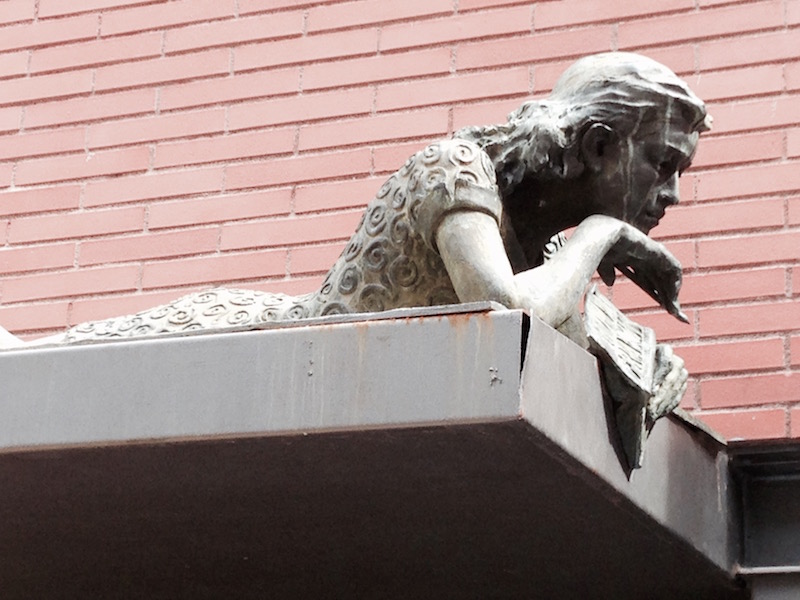
One of the many wonderful things about exploring Barcelona is happening across curious architectural details and sculptures in unexpected places.

A sculpture of Anne Frank in Gràcia, Barcelona

In Gràcia, on Travessia de Sant Antoni, midway between Carrer d’Astúries and Carrer del Montseny, you’ll find the little square, Plaça d’Anna Frank and a sculpture of Anne Frank. She reclines on a canopy affixed to the Centre Artesà Tradicionarius — a cultural centre dedicated to the production and promotion of catalan music and dance.

Sculpture of Anne Frank in Gràcia, Barcelona, by Bill Sinclair.

Enjoy Barcelona

Getting Around

How to get your bearings as you explore Gràcia

4th June 2015
Compass

Educated monkey calculators and compasses as displayed at Vinçon.


Arrival

Well done, you’ve arrived ready to explore Gràcia. Congratulate yourself on your good judgement.

  • If you arrived via metro Line 3 and alighted at Fontana you are now at the junction of Gran de Gràcia and Carrer d’Asturies. If you alighted at Lesseps you will be very near the junction of Gran de Gràcia with Traveserra de Dalt.
  • If you arrived via metro Line 4 at Joanic you will be at the junction of Carrer Pi i Maragall with Carrer de l’Escorial.
  • If you arrived by FGC train you’ll be on Via Augusta, in, or very close to Plaça de Gal·la Placidia, and very near the junction with Traveserra de Gràcia.
  • If you arrived by the 22, 24 or V17 bus you will be on Gran de Gràcia.
  • If you arrived on the V15 bus you’ll be on Via Augusta.
  • If you arrived on the 55 bus you’ll be at the junction of Passeig de Sant Joan and Traveserra de Gràcia.
  • If you arrived on foot, by bike, or fell from the skies — well, you could be anywhere, but not so very far from somewhere.

Orientation

First thing to understand is that although most maps seem to show Gràcia as being North of the city centre, because most maps situate the city as being between the mountain (usually at the top of the map) and the sea (usually at the bottom of the map) Gràcia is really north-west of the city centre.

Not that important, unless you’re using a compass to navigate around the city, but useful to know.

Second thing to note is that some maps confuse the barrio of Gràcia, i.e. what used to be the township of Gràcia, with the political district of Gràcia. So, for example, I live in Eixample Dreta but reside in the political district of Gràcia.

Again, not that important, but something to be aware of when consulting some maps, especially maps produced by the Ajuntament (City Hall).

IMPORTANT: Older maps and guidebooks will show a square called Plaça de Rius i Taulet. This square, the main town square, is now known as Plaça de la Vila.

Boundaries

For our purposes, Gràcia’s boundaries can be defined as Carrer Còrsega and Avinguda Diagonal Continue Reading…